Upcoming Events
See video from recent eventsFeatured Event
Wednesday March 25 2026 • 02:30 PM — 06:00 PM
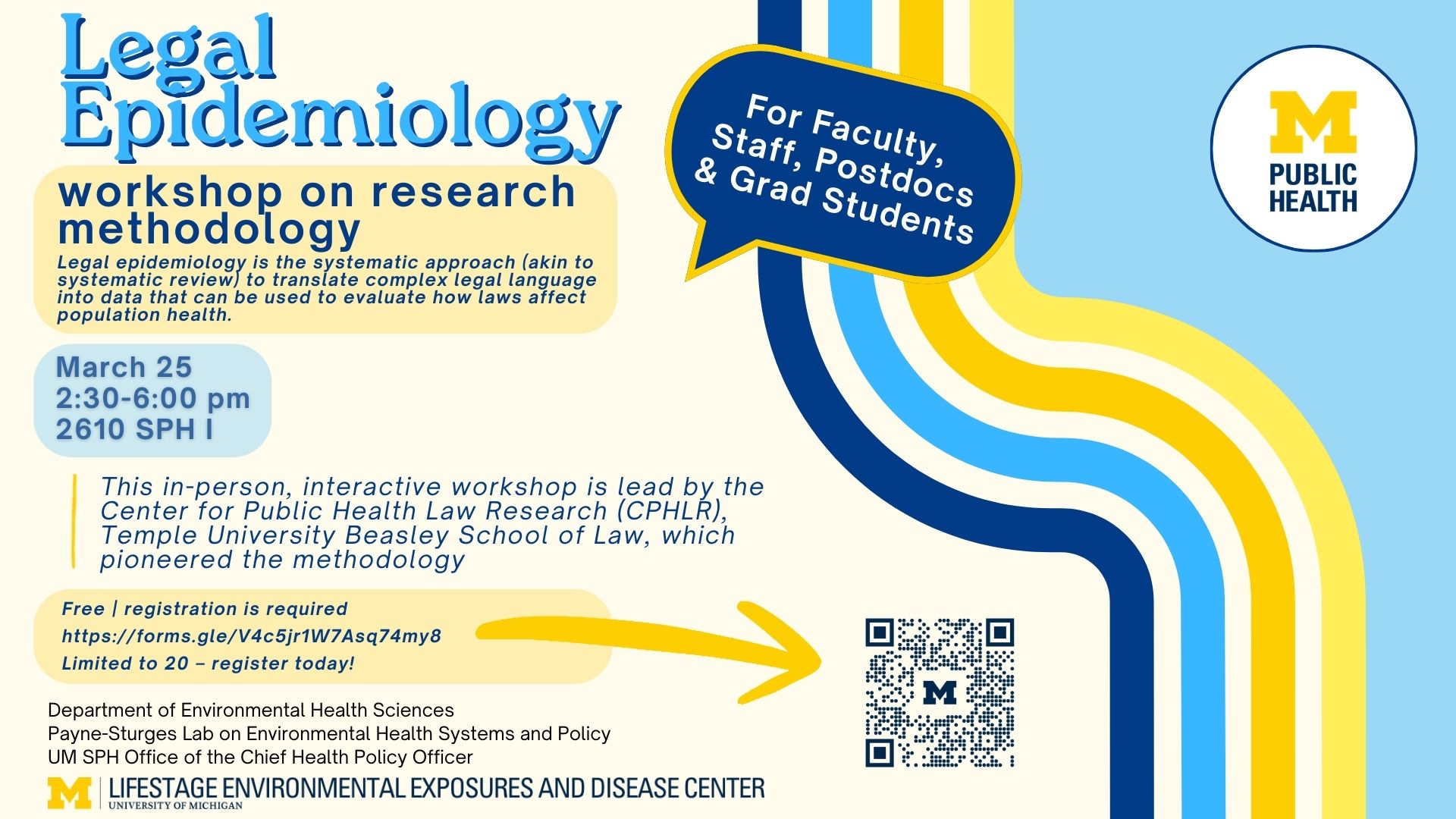
“Legal Epidemiology: Workshop on Research Methodology”
Please note: Registration is required. This workshop is limited to the first 20 registrants due to space limitations. This event will not be livestreamed.
This Legal Epidemiology workshop is a systematic approach (akin to systematic review) to translate complex legal language into data that can be used to evaluate how laws affect population health.
Who should attend? Are you interested in conducting research to evaluate the impact of laws and policies on public health but have never created a legal data set for use in research? This workshop, on research methodology, is for graduate students, post docs, faculty and staff.
Location: In person only -- 2610 SPH 1 (School of Public Health, 1415 Washington Heights)
Workshop Leaders: Experts from the Center for Public Health Law Research (CPHLR), Temple University Beasley School of Law, will conduct this interactive and collaborative workshop.
Goals: Workshop provides an introduction to public health law and emphasize the role and use of legal epidemiology and scientific legal mapping in health policy research.
- Learn MonQcle, developed and deployed by CPHLR, a web-based software platform for creating and publishing legal data in maps, tables and research-ready csv files.
- Learn about the transdisciplinary field of public health law and the Five Essential Public Health Law Services.
- Receive training resources, including slide deck and hands-on policy surveillance exercises.
- Develop an understanding of legal epidemiology, also known as public health law research. This will include a discussion of legal mapping methods.
- Learn the value and potential of using legal data for health policy research.
Registration: Join us in-person .
Sponsored by: Department of Environmental Health Sciences, the Payne-Sturges Lab on environmental health systems and policy, UM SPH's Office of the Chief Health Policy Officer, and the University of Michigan Center on Lifestage Environmental Exposures and Disease (M-LEEaD).