Contact Rose Branstrom with any items that should be included in next month's M-LEEaD newsletter.
M-
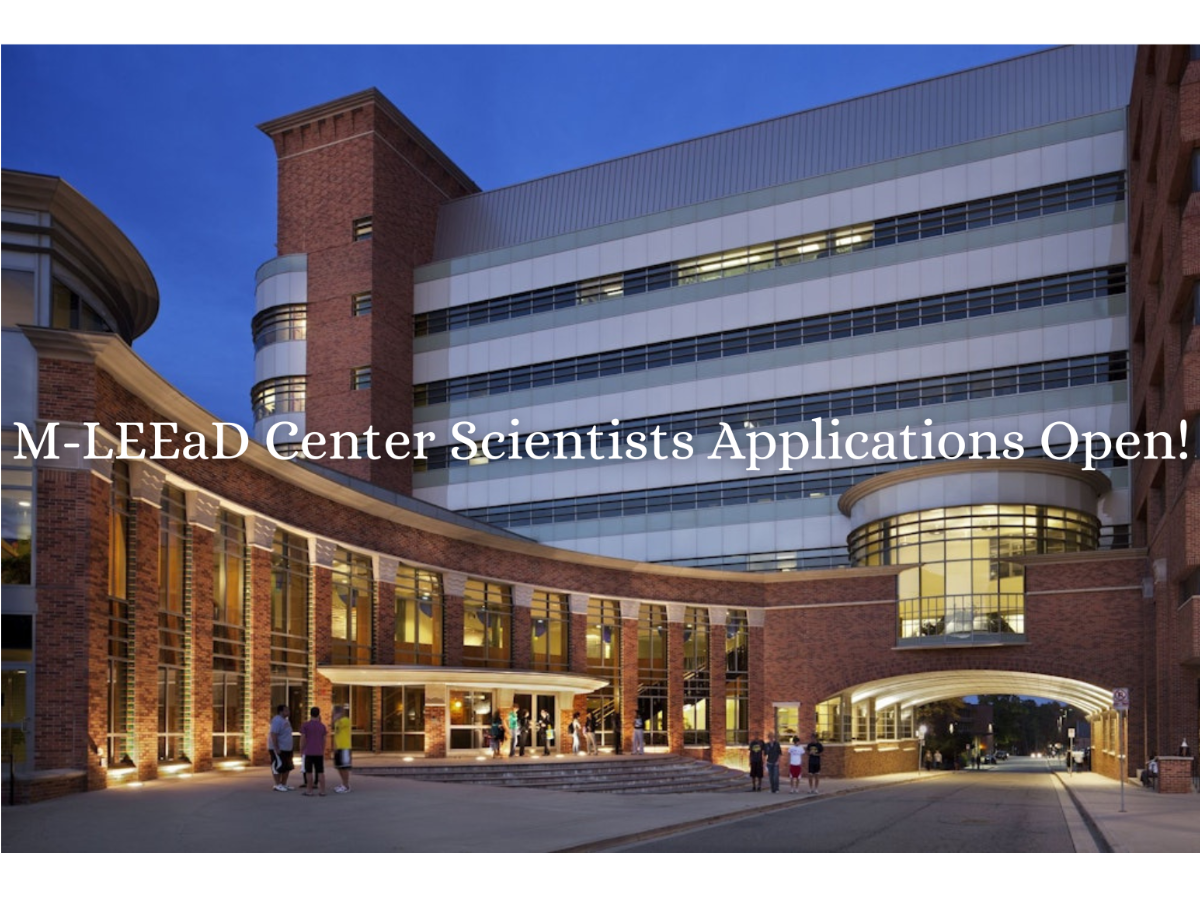
LEEaD is now accepting applications for the two 2025-2026 Center
Scientists positions. The Center Scientist positions provide special
mentorship and core engagement for the selected early-stage
investigators and include a contribution to salary and benefits.
Selected Center Scientists are expected to engage in research that
addresses the goals of the M-LEEaD Center to define, explain, or
mitigate impacts of environmental exposures during vulnerable stages of
life, or contribute to the priorities of the NIEHS Strategic Plan.
Due to new Department of Health and Human Services (HHS) priorities,
applicants are strongly encouraged to contact Rose Branstrom,
Administrative Assistant for M-LEEaD (rbranstr@umich.edu) with an
informal summary of their 2025-2026 Center Scientist Research Plan and
Training Goals before working on their entire application to ensure the
research is in alignment with HHS priorities.
We strongly encourage faculty members of the M-LEEaD Center to identify
and encourage eligible candidates to apply and to offer to provide a
letter of support. Applicants must be from within the University of
Michigan and can be current postdoctoral trainees, research fellows, or
recent junior faculty (appointed as research investigator, assistant
research scientist, research assistant professor, or clinical assistant
professor within the past three years).
The due date for applications is July 28, 2025.
Questions? Contact M-LEEaD's Center Administrator Rose Branstrom
(rbranstr@umich.edu), or the Career Development Leadership team,
Gil Omenn (gomenn@umich.edu), and Justin Colacino
(colacino@umich.edu).
Michigan Public Health Launches Campaign to Emphasize the Importance of Public Health Research
The
University of Michigan School of Public Health has launched a bold new
campaign to highlight the critical impact of public health research.
This campaign highlights how public health research helps prevent
illness and injury. "They are not just studying these problems—they are
finding ways to prevent conditions, improve treatments, and break down
barriers to quality care," says John Meeker. Read more here and visit the comprehensive online hub for additional resources.
M-LEEaD Members Speak Out Against NIOSH Cuts Risking Michigan Workers' Health and Safety in Detroit News
Every
year, more than 75,000 workers are killed by occupational injuries or
prolonged exposure to hazardous substances. Adults often spend half
their waking hours at work, and most of us know someone who has been
hurt or sickened by their work. Eliminating early all staff and
programs of the National Institute for Occupational Safety and Health
(NIOSH) threatens the lives of workers and the health of the economy
across America— including in Michigan. Learn more here.
Jennifer Head, M-LEEaD Member, Investigates the Spread of Fungal Infections Due To Climate Change
Fungal
pathogens are often somewhat of an apparition, an unexpected and
seemingly invisible opponent of good health, until they are exposed
under a laboratory lens or on a chest X-ray. Head is helping to compose
the book on understanding these potent vectors of disease, which
sometimes can be misdiagnosed as pneumonia, tuberculosis or cancer. She
hopes to see an increase in the healthcare community’s awareness of
their fingerprints and the dangers these pathogens can pose to everyone,
especially those people who are most at risk. Learn more here.
WEMU Spotlights M-LEEaD Member Eva Felman on Environmental Pollution and Rising ALS Cases
Doctors
in Michigan are seeing an increase in ALS patients. Amyotrophic Lateral
Sclerosis, or Lou Gehrig’s Disease, affects nerve cells in the brain
and spinal cord. The increase in Amyotrophic Lateral Sclerosis (ALS) is
attributed to environmental pollution, specifically in the agriculture
and manufacturing industries. Eva Feldman is the director of the ALS
Center of Excellence at the University of Michigan. She says cases of
the disease that causes people to lose their ability to speak or move
are rising. Read more here.
M-LEEaD Member Dave Bridges’ Nutrition Expertise Featured in The New York Times
On
a per-calorie basis, there aren't many whole foods richer in protein
than chicken breast. “You'd have to eat protein powder to get more
protein,” said Dave Bridges, a biochemist and associate professor of
nutritional sciences at the University of Michigan. Read more here.
Research on ALS and Harmful Algal Blooms Featured in Michigan Med Health Lab, News Medical, and Science Blog
Living
close to cyanobacterial harmful algal blooms heightens the rate of
dying from amyotrophic lateral sclerosis, or ALS, a study suggests.
These blooms occur when cyanobacteria, also called blue-green algae,
grows dense and out of control, producing toxic agents that can poison
people and the environment. Researchers at Michigan Medicine
surveyed participants with ALS who were seen at the University of
Michigan Pranger ALS Clinic. Read more in Michigan Med Health Lab, News Medical, and Science Blog.
Statistical Consulting Available Through the Summer
While
regular office hours are on pause for the summer, the M-LEEaD
Integrated Health Sciences Core is still here to support your research.
If you have any statistical questions, you can reach out via email or
set up a one-on-one Zoom consultation.
To schedule a session or ask a question, contact Lingxuan Kong at lingxuko@umich.edu.
Joint
Annual Meeting of the International Society of Exposure Science and the
International Society for Environmental Epidemiology 2025
The
overall theme is “Global Environmental Health Equity across the
Lifespan”. With the rich civil rights history of Atlanta, the theme
integrates equality with environmental health.
Dates: August 17th - August 20th, 2025
Location: Atlanta, Georgia Learn more here
Complementary Workshop for ISEE-ISES 2025: How to Conduct Gold Standard Systematic Reviews
This
workshop is a companion to the ISEE-ISES 2025 pre-meeting systematic
review workshop (WS04). How to Conduct Gold Standard Systematic Reviews
will teach the key steps to conducting best practice systematic reviews,
including problem identification, protocol development, study search
strategy, and evidence synthesis.
Dates: August 17th, 2025
Time: 9 am to 12 pm
Location: Atlanta, Georgia Learn more here
Santiago Exposome Symposium:
Integrating Environmental Exposures into Aging,
Alzheimer’s Disease and ADRD Research
The
Second Latin American Exposome Symposium will be held at the University
of Chile in Santiago, focusing on the theme “Integrating Environmental
Exposures into Aging and Alzheimer’s Research.” This event will bring
together leading scientists in Alzheimer’s Disease and Related Dementias
(ADRD), Environmental Health, and Exposomics to examine how
environmental exposures impact ADRD.
Dates: September 25th - September 27th, 2025
Location: Casa Central, University of Chile, Santiago, Chile Learn more here
University of Michigan Climate Week 2025
U-M Climate Week 2025 (UMCW25): Together for Tomorrow
Location: University of Michigan, Ann Arbor
Date: September 27–October 5, 2025: October 28th, 2025 - October 30th, 2025 Save the Date here
Third Annual Data Sharing Symposium: How Data Advances the Impact of Cancer Research
On
September 30 and October 1, 2025, the NCI Office of Data Sharing (ODS)
is hosting the Third Annual Data Sharing Symposium: How Data Advances
the Impact of Cancer Research inside the NCI Shady Grove Campus in
Rockville, MD. Learn more here.
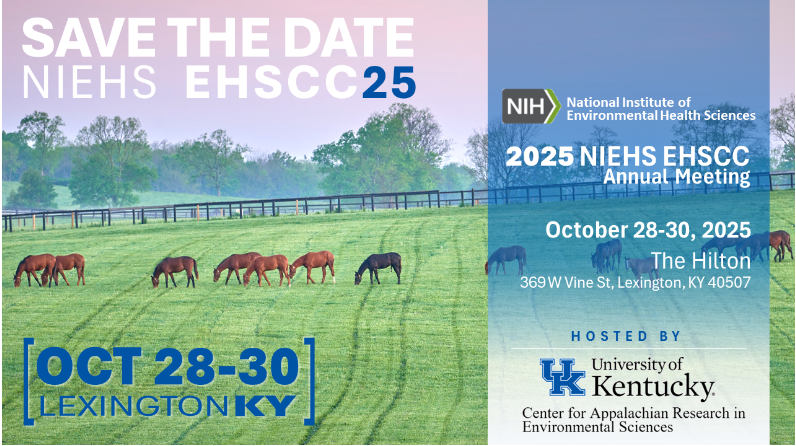
2025 NIEHS EHSCC ANNUAL MEETING
Date: October 28th, 2025 - October 30th, 2025
Location: Lexington, KY Save the Date here
Request for Information (RFI): Benchmarks for Artificial Intelligence in Cancer Research and Care
The
purpose of this Request for Information (RFI) is to solicit broad
community input on priority artificial intelligence (AI) benchmarks and
associated benchmark datasets to advance the development, evaluation,
and validation of AI applications in cancer research and care. Learn
more here.
Application Deadline: July 30, 2025
Recent Publications citing M-LEEaD:
Irfan, B., Bakulski, K., Reader, J., &
Rahman-Filipiak, A. (2025, June 14). Moving from dementia risk
disclosure to return of individual research results: A bioethics
perspective. The Lancet Healthy Longevity. https://doi.org/10.1016/j.lanhl.2025.100723
Nguyen, V. K., Zimmerman, S., Colacino, J.,
Jolliet, O., & Patel, C. J. (2025). Body dissatisfaction widens the
racial disparities of Benzophenone-3, a chemical biomarker of personal
care and consumer product usage. Environment International, 202, 109557.
https://doi.org/10.1016/j.envint.2025.109557
Park, S., Cathey, A. L., Hao, W., Park, S. K., Mukherjee, B., Montañez, G. H., Rosario Pabón, Z. Y., Vélez Vega, C. M., Cordero, J. F., Alshawabkeh, A., Watkins, D. J., & Meeker, J. D.
(2025). Prenatal exposure to phthalate mixtures and child
neurodevelopment in toddlers aged 1-3 years from the PROTECT birth
cohort. International journal of hygiene and environmental health, 268, 114599. Advance online publication. https://doi.org/10.1016/j.ijheh.2025.114599
Click here for a PDF with useful information about NIH Public Access Policy regarding citing the center grant.
Per
NIH grants policy, all publications, press releases, and other
documents relevant to research funded by the center must include a
specific acknowledgement of support. For the EHS Core Center, this
statement may read:
“Support
for this research was provided by grant P30ES017885 from the National
Institute of Environmental Health Sciences, National Institutes of
Health. The content is solely the responsibility of the authors and does
not necessarily represent the official views of the National Institutes
of Health.”